At home, but not alone

Kent Community Health NHS Foundation Trust (KCHFT) is leading the way on providing hospital-level treatment, for patients who need urgent care but want to stay at home with friends and family, if they can.
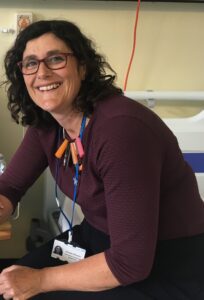
Dr Shelagh O'Riordan
The service has rapidly expanded since the covid-19 pandemic, when consultant geriatrician Dr Shelagh O'Riordan, from the KCHFT Frailty Home Treatment Service recognised the need to be able to keep frail, elderly people out of hospital for as long as possible. Since then, the team has increased the range of diagnostics they can offer in people's homes, including rapid blood testing, electrocardiograms and ultrasound – and treatments such as intravenous antibiotics, iron infusions and oxygen.
Dr O'Riordan said: "Our aim is to keep people safe and well at home, especially those living with frailty. When we can treat people at home, it's better for the patient, better for the family and ultimately better for the whole community, as we can free up hospital beds for people who do need to be there."
Consultant Advanced Clinical Practitioner Sharel Cole said: “People always say it 'blows them away' when they see the range of equipment and support we can provide to people in the community. We bring all the care they need to them, reducing hospital admissions and supporting families at every stage.
“We’re also now beginning to work more closely with colleagues at Kent and Medway Mental Health Trust to support people living with dementia and their carers.
“What matters most to our patients is quality of life. Time and being with their friends, careers and relatives is precious to them, so being at home and avoiding hospital, if they can, is especially important.”
Anne’s angels
When Jean Holland from Herne Bay found her 92-year-old mother Anne unconscious and slumped over in the bathroom one Wednesday morning, her first thought was that Anne had suffered a stroke. “Her breathing was laboured and her legs and abdomen were convulsing,” Jean recalled. “It was terrifying.”
Jean called 999 immediately. She said: “As I hung up, the ambulance crew were already at the door. They were amazing.” But what happened next was unexpected. Instead of rushing Anne to hospital, the paramedics referred her to Kent Community Health NHS Foundation Trust’s Frailty Home Treatment Service.
“I’d never heard of it,” Jean admitted. “I thought it was another occupational health team, like the mobility team we’d had before. But it was so much more.”
Within the hour, Helen Field-Stevens from the Frailty Team had arrived at the tidy bungalow Jean and Anne share by the sea. “She was absolutely marvellous,” Jean said. “So calm and gentle. She had a whole sackbarrow of equipment and she set it all up on the table. She stayed for three hours, monitoring Mum, doing blood tests and even catheterising her when she realised Anne wasn’t emptying her bladder properly.”

Anne at home with her daughter Jean.
Despite the initial scare, no infection was found, and Anne was able to stay at home — something she’d made clear she wanted. “Mum has a RESPECT form in place. She doesn’t want hospital treatment unless it’s absolutely necessary,” Jean explained. “And honestly, who does? Hospitals are overstretched and elderly people can deteriorate quickly in that environment.”
The service didn’t stop with Helen’s visit. Jean was given a Doccla home monitoring kit — a mobile tablet and equipment that allows her to check and report Anne’s blood pressure, oxygen levels, temperature and more, twice a day. “It’s so easy to use,” Jean said. “The tablet guides you through each step, and the data goes straight to the Frailty Service. If anything’s off, they call or come over.”
“We’ve had calls nearly every day to check on us. One of the doctors rang the day after the episode and has followed up since. They couldn’t be more attentive.”
Jean, who reduced her work hours to care for Anne, said the service has made a huge difference. “It’s given us peace of mind. We’re not alone. We have expert support, and Mum gets to stay in her own home.”
Her message to others? “Don’t assume hospital is the only option and let this put you off asking for help. This service is extraordinary. It’s person-centred, responsive and it works.”
No place like home for healing: How Patrick was kept safe and out of hospital
When 84-year-old Patrick Conroy fell seriously ill at home in Swalecliffe, his family feared they’d have no choice but to send him to hospital — a daunting prospect for someone living with dementia and heart failure. But thanks to the Frailty Home Treatment Service, Patrick received expert care right in his own home, surrounded by the people and routines he knows best.

Sharel Cole, Jo Conroy, Patrick Conroy, Ben Conroy and Violet Chikomba (l-r)
Patrick has lived with son Ben and daughter-in-law Jo, for over a decade. “We built a lodge at the end of the garden to be close to both mum and dad,” Ben explained. “Sadly, we lost mum in February and it was then dad’s health seemed to take a turn for the worse.”
One evening, Patrick became incoherent and showed signs of a stroke. The paramedics who arrived were quick to suggest an alternative to hospital; the Home Treatment Service. “They were amazing,” said Ben. “They said, ‘We’ll keep him at home if we can,’ as that was what we wanted. They put us in touch with the team.”
The team diagnosed decompensated heart failure and administered IV diuretics over several days, followed by oral medication – all at home. Patrick’s condition improved dramatically. Jo recalls:“It was like a little hospital had come to our house.”
The service didn’t stop there. The team helped arrange an iron infusion, occupational therapy assessments and even a hospital bed to improve Patrick’s sleep and safety. “It’s comforting to know we can get the care we need here at home,” said Jo. “He’s got his bed, his routine and importantly, we’re not spending 18 hours in A&E.”
For Patrick and his family, the service has been a lifesaver. “We didn’t know it existed,” Ben said. “Now we can’t imagine coping without it.”
What can the urgent care service provide at home?
The service can provide a wide variety of treatments to diagnose people and keep them well at home, including:
- on-the-spot blood tests
- ultrasound
- echocardiogram
- intravenous therapy
- oxygen
- medication
- end-of-life care where appropriate.
Watch our film to find out what else our team can provide at home.


